

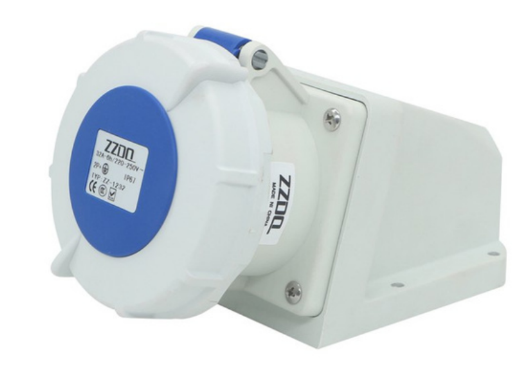
The industrial sockets are designed to be used in many environments according to the application where the industrial socket is needed. The secure reason is one of the top priorities when you choose an industrial socket. Especially when the products are used in the place of heavy dust and wet. A waterproof industrial socket is invented driven by this requirement. Not all industrial sockets are waterproof. No matter which manufacturer produces it, they have the waterproof socket something in common. The housing material: for a water-resistant industrial socket, the shell is made by PP (polypropylene) / PA (Nylon, Polyamide). These materials have good stability to water. Besides, they have a wide temperature range of tolerance from -40°C to 90°C. The inner parts: almost all the plastic inner parts are made by flameproof PA material. Actually, for a waterproof industrial socket, it is also a flameproof product. For a waterproof industrial socket, you will find one of these marks on the shell IP44, IP55, or IP67. What is that? These marks are called IP degree, an abbreviation for Ingress Protection rating.
The IP degree is recommended by IEC. It has as many as 9 categories of protection rating, using for defining how an electric device is water and dust resistant. In different application environments, the rating level will be different. The correct writing of a IP degree is IPXX, take IP67 for example. The first number “6” refers to the dust protection rating.
From IEC (cee), there are 7 categories to describe dustproof rating. They are numbers from 0 to 6. The 6 is the highest rating, meaning that the dust is completely prevented from entering into the device. The second number “7” refers to the water resistance capability. Similar to the dustproof grades, there are 9 waterproof degrees, showing with numbers from 0 to 8. The 7 is the second-highest protection rating, meaning
that the socket can still work safely when it is underwater (no deeper than 1 meter) in a short time. For the waterproof industrial socket, there are 3 grades which are the most commonly seen: IP44, IP55, IP67.
